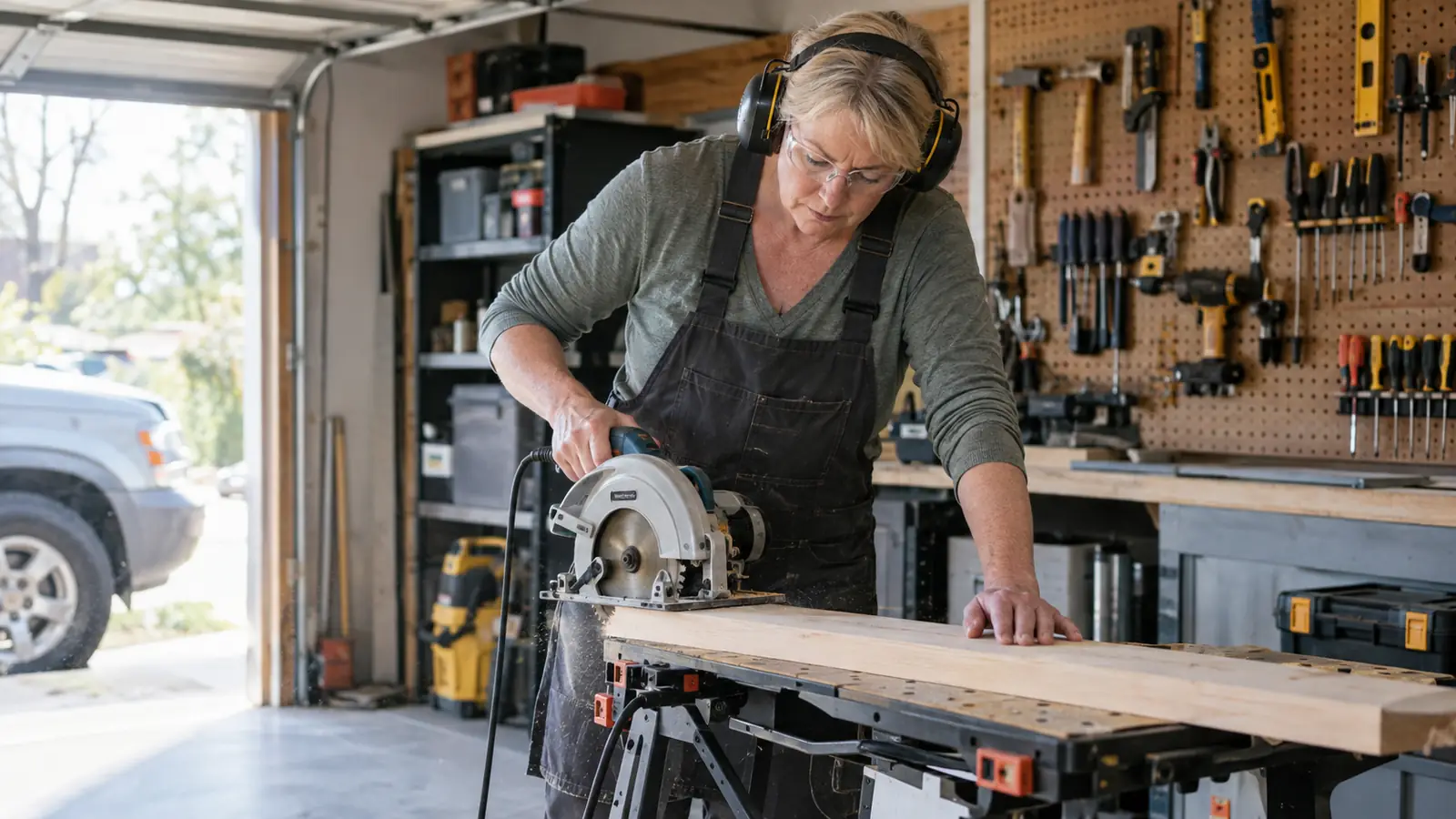
Standing in the hardware aisle trying to decide between a cheap box of foam earplugs and a pair of Pro For Sho ear muffs, I have been exactly where you are. I am Peggy Hollister, I am 58, and I have worn both on the same jobs in my garage outside Spokane. Last October, on a Tuesday morning, I was replacing three rotted deck boards on the back steps. I started the day with foam earplugs the way I always had, rolling them between my fingers and shoving them in. By noon I had pulled them out twice because they were making my ear canals ache, and the second time I put them back in a hurry while balancing a board on my knee. I ran the circular saw for the better part of twenty minutes with a plug sitting crooked in my right ear. I did not realize how loud everything had felt until the board was cut and the saw was off and I could hear the garage fan again. That afternoon I dug the Pro For Sho muffs off the pegboard, slid them over my head, and finished the last two boards in about fifteen minutes. The difference was not subtle. Since then I have worn both on saw work, sanding, and a bathroom refresh, and I have opinions I am happy to share.
The short answer: for saw work, the Pro For Sho ear muffs win. For sleeping on a camping trip, or a quick job where you still want to hear a car coming, foam earplugs still have a place. But if your question is which one is worth your money for power tool work, the muffs earn it. Here is the honest breakdown, the way I would give it to you across the workbench.
| Pro For Sho Ear Muffs | Foam Earplugs | |
|---|---|---|
| Noise reduction | 34dB NRR, consistent every time you put them on | Around 32dB NRR when inserted perfectly, less when you rush |
| Ease of use | Slip on and go, one motion, no fiddling | Roll, pinch, pull your ear, hold and wait to expand |
| Comfort over a long job | Padded cups with room inside, no pressure in the ear canal | Fine for an hour, then the pressure in your ear canal starts to talk to you |
| Hearing what matters | Muffles the saw but you can still hear a shout or a knock at the garage door | When they are in right, you are sealed off from almost everything |
| Cost per use | One pair, used for years, no restocking | Cheap per box, but you rebuy them and they wear out fast |
| Portability | Bulky in a toolbox, fine on a hook in the garage | A tiny case you can keep in a coat pocket |
| Best for | Saw work, sanding, anything with a motor running for more than a few minutes | Sleeping, travel, or a quick cut where you want to stay aware of your surroundings |
Where Pro For Sho Wins
The first thing I noticed was how easy the Pro For Sho muffs are. With foam earplugs, I had to roll the plug into a thin snake between my fingers, reach over my head with the other hand to pull my ear open, push the plug in, and hold it while it expanded. If I rushed, which I always did, I got maybe half the protection. One afternoon last spring I timed myself with a stopwatch out of pure frustration: forty seconds of rolling, pinching, and holding, and one plug still sat crooked enough that the saw sounded loud in my left ear. The package says the Pro For Sho muffs block 34dB of noise, and they do that every single time I put them on, because there is no insertion skill involved. I just slide them over my head and the cups seat themselves over my ears. The band has a little flex, so it does not press hard on the top of my skull, and the cups tilt at the hinge to match the angle of my head. On a Saturday morning when the coffee has not kicked in yet, that one-motion fit matters more than you would think. I keep the muffs hanging on a hook right above the pegboard, within arm's reach of the saw cord, so I do not even have to walk across the garage to grab them. It sounds like a small thing, but the fewer steps between deciding to protect my ears and actually protecting them, the more often I will do it.
The other win is comfort over time, and this one surprised me. Foam plugs start to ache in my ear canal after about an hour, and by hour two I am pulling them out to give my ears a rest, which defeats the whole point. The Pro For Sho muffs have padded cups with enough room inside that my ears are not pressed flat. I wore them for three and a half hours one Saturday in June while I sanded and refinished a bathroom vanity top, first with a palm sander, then by hand with 120 grit. The vanity came out of the half bath off the kitchen, an old oak top with a layer of polyurethane that had gone amber and crackled. The palm sander ran for most of the first two hours, and that motor is exactly the kind of steady drone that used to leave my ears feeling stuffed. By the time I switched to hand sanding the edges, I had stopped noticing the muffs entirely. Somewhere around hour two I forgot they were on, which has never happened with foam plugs. The only thing I noticed when I took them off was a warm spot where the padding had sat. No ringing in my ears at the end of the day, and that is the part I care about most. Hearing damage is sneaky. It does not hurt while it is happening, it just shows up years later when you are asking people to repeat themselves at dinner. For a person with smaller ears, the fit is still snug without being tight. The headband adjusts, and the cups swivel a little, so they settle into place instead of fighting my head shape. A friend from my Tuesday night bowling league borrowed them for an afternoon of leaf blowing and came back saying the same thing, which is how I know it is not just my head.
There is one more thing the muffs do that foam plugs cannot, and it is the reason I reach for them on saw work specifically. They cut the high whine of the saw blade down to a tolerable level, but they do not turn the world off. I can still hear a shout from across the yard, a car door slamming at the end of the driveway, or one of the grandkids calling my name. Two weeks ago I was cutting a replacement shelf for the linen closet when my neighbor hollered from the driveway that a package had been left on the porch. I heard him over the saw, which I would not have with plugs in. With foam plugs in properly, especially the high-NRR ones, I am sealed off. Out at the saw table, I would rather have the muffled awareness the Pro For Sho pair gives me. It is a safety thing, not just a comfort thing.

Where Foam Earplugs Win
I am not going to pretend foam earplugs are useless, because they are not. They win on portability, plain and simple. A little case of foam plugs fits in my coat pocket, my bowling bag, even the tiny pocket on my jeans. The Pro For Sho muffs are bulky. They hang on a hook in my garage, and they stay there. When I go over to the neighbor's house to help him hang drywall in his basement, the foam plugs go in my jacket pocket and I do not think about them again. The drywall job took us two evenings in March, and the plugs sat in that pocket the whole time, right next to a stub of pencil and the tape measure I keep forgetting to return. When I grab the leaf blower out of the shed for a quick pass over the driveway, same thing. The muffs would mean a trip back into the house. So for the jobs that are short and scattered, foam plugs win on convenience, and I am not going to argue with that. There is a reason every hardware store keeps a big box of them by the register.
Foam plugs also win when you want to stay aware of your surroundings. When they are inserted properly, they block a lot, but they do not create the same sealed-off feeling as a full muff. For mowing the lawn, where I still want to hear a car coming down the street or a neighbor calling my name from the fence, foam plugs let me keep some awareness. And for sleeping, which I do on long car trips with the grandkids, foam plugs are the only option I would consider. Last spring I drove the grandkids to the coast, about five hours each way, and I napped in the passenger seat on the way home with a pair of foam plugs in. The wind was coming off the water and the tires were humming on the concrete, and I was glad the plugs were in the door pocket. You cannot sleep in ear muffs, and I say that as someone who has tried. On a motel room floor with a noisy air conditioner, or in a camper van with the wind rattling the door, molded around an ear canal is the only way to go.
I will also say this for foam plugs: they are easier to share. When the neighbor helps with a project and hands a pair to his teenager, they fit either of them fine. Some folks just do not like anything on their head, and foam plugs are one-size-fits-all in a way muffs are not. And when a box of foam plugs sits in the glovebox of the truck, they are there even if I forgot to grab the muffs off the hook. Half of hearing protection is having something to put on in the moment, and foam plugs are the ones that are always within reach.
The muffs I reach for every time I fire up the saw
After a full season of projects, the Pro For Sho 34dB NRR ear muffs are the pair hanging on my pegboard. If you do any regular saw work, they are the ones worth buying.
Amazon Check Today's Price on Amazon →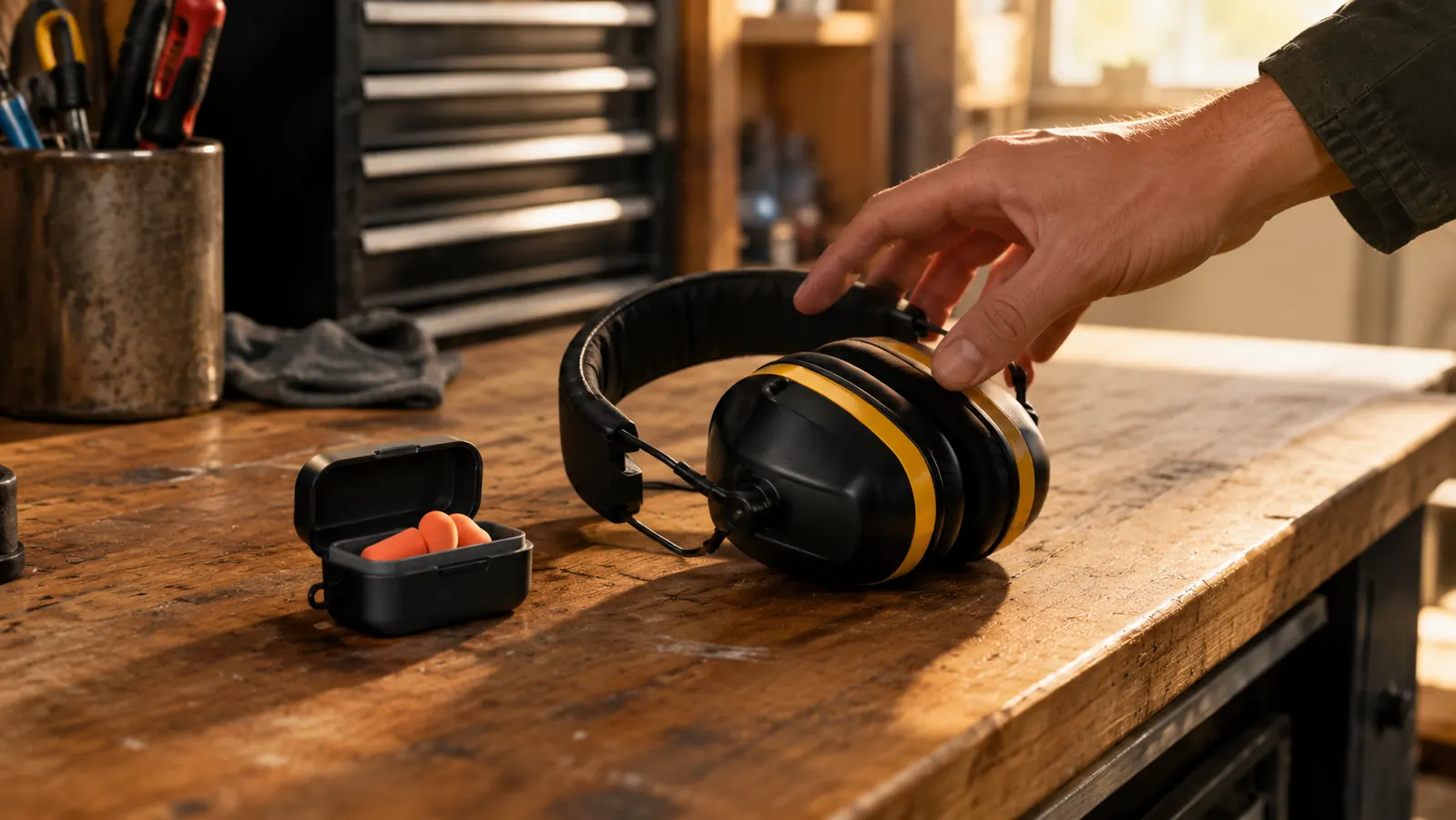
Who Should Buy Which
Buy the Pro For Sho ear muffs if you do any regular work with power tools. If you are cutting, sanding, or running a saw for more than a few minutes at a time, the consistent 34dB NRR and the comfortable fit make them the better buy. They cost more up front than a box of foam plugs, but they last for years and you never have to remember to restock them. For a weekend DIYer who wants to protect their hearing without thinking about it, the Pro For Sho muffs are the ones I would put in your cart. I do not say that lightly. Hearing does not come back, and I have known too many people who spent a lifetime around saws and now turn the TV up all the way.
Stick with foam earplugs if your main need is portability, sleeping, or the occasional quick job where you want to stay aware of your surroundings. They are cheap, they are small, and they have their place. But if you are honest with yourself about how often you use power tools, the muffs are the ones that will actually be on your head when it matters. I keep both in my garage, and I reach for the Pro For Sho pair every time I fire up the saw. That is the whole review in one sentence.
I know some of you are reading this because you already own a pair of foam plugs and you are wondering whether the muffs are worth the upgrade. My honest answer is yes, if you run power tools more than once or twice a year. The Pro For Sho pair has been on my head for every saw cut since that October afternoon, and it has paid for itself in peace of mind alone. I liked them well enough to pick up a second pair for the neighbor's toolbox last spring, which should tell you how I feel. But I did not throw the foam plugs away. They stay in the truck, in the bowling bag, and in the camping bin, and they get used. Hearing protection is not an either-or. It is a both.
Protect your hearing without the fuss
The Pro For Sho 34dB NRR ear muffs are the pair I trust for every saw job. One motion to put them on, consistent protection all afternoon, and they hang on the pegboard ready for next time.
Amazon Check Today's Price on Amazon →