
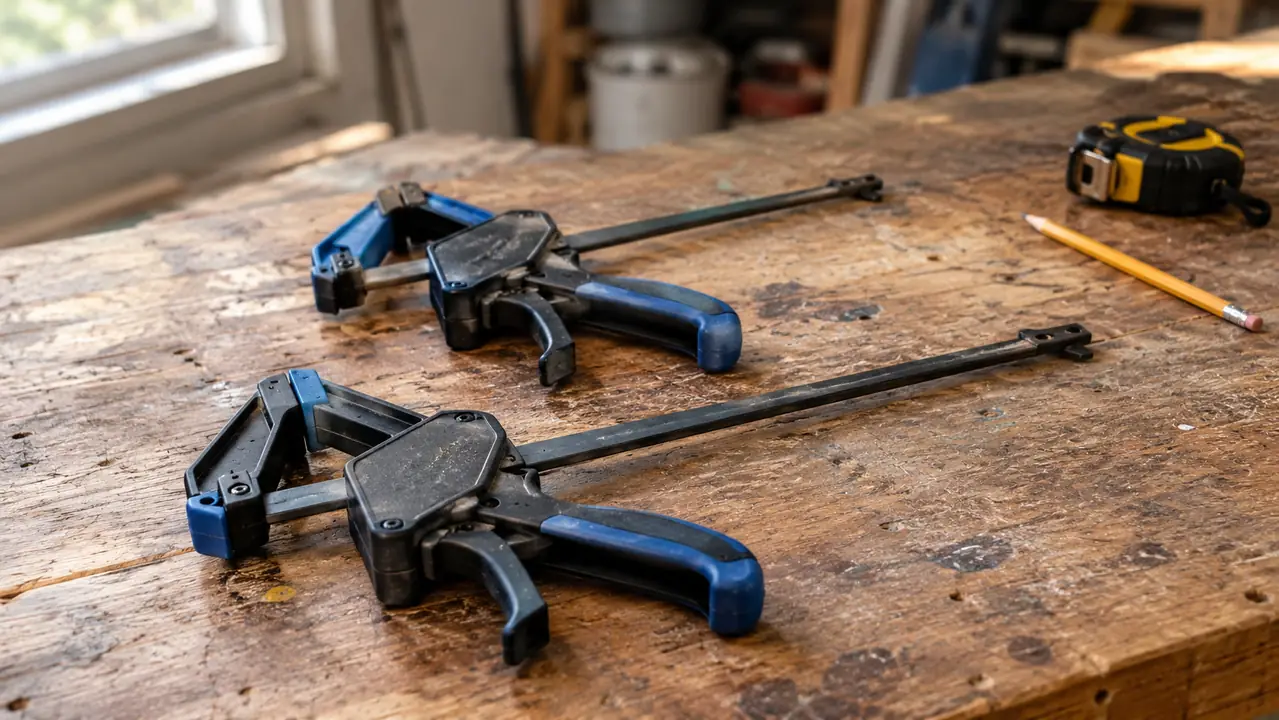
I will be honest with you. When I first picked up a pack of IRWIN Quick-Grip mini bar clamps, I figured they were a nice idea that would spend most of their life in a drawer. I have been doing projects long enough to be skeptical of anything that promises to make clamping easier. Then I spent six months reaching for them on almost every job in my garage, and I changed my mind. This is the review I wish someone had handed me before I bought them, with the good parts, the frustrating parts, and the one thing I would change if I could.
I am Peggy, and I do my projects in one side of a two-car garage outside Spokane. My workbench is a folding one, my pegboard wall holds the tools I use most, and my hands are not what you would call big. That last part matters more than you might think when you are squeezing a clamp trigger a hundred times in an afternoon. So this review is not written from a test lab. It is written from a garage where things actually get built, taken apart, and built again.
The Quick Verdict
The IRWIN Quick-Grip mini bar clamps are the clamps I reach for first on small jobs. They are fast, easy on the hands, and reliable, but they are not a replacement for a deep-throat clamp when you need serious reach.
Amazon Check Today's Price →The clamps I keep reaching for on every small job
If you are tired of fighting with C-clamps and want something you can open and close with one hand, this is the pack to start with. See today's price on Amazon and decide for yourself.
Amazon Check Today's Price on Amazon →How I Have Used Them
I have had my pack of four IRWIN Quick-Grip mini bar clamps for about six months now. In that time they have held deck boards while I checked the gap, glued up a shelf that had split along the grain, clamped trim while the adhesive set, and held a piece of plywood steady while I drilled pocket holes. They have also done the job that surprises everyone: holding a phone upright so I could watch a how-to video while I worked. That last one was not in the manual, but it worked.
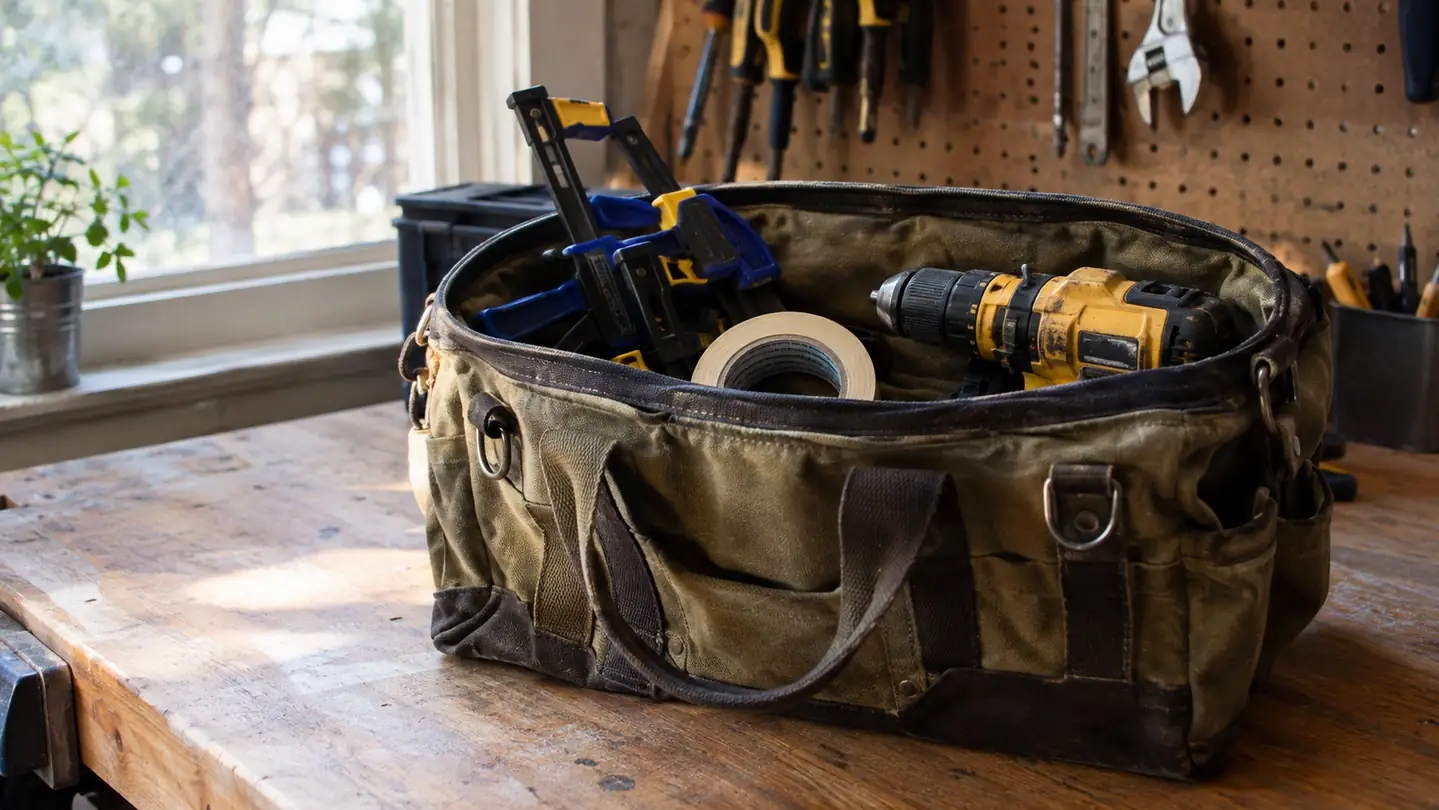
The 6-inch size means the jaws open wide enough for most small shop tasks but stay compact enough to toss into a tool bag. I keep two of them in a small box on my workbench and two in the bag I carry when I am working on a project in another room. That is the honest measure of a tool for me. If it stays in the drawer, it was not worth the money. These have not been in the drawer.
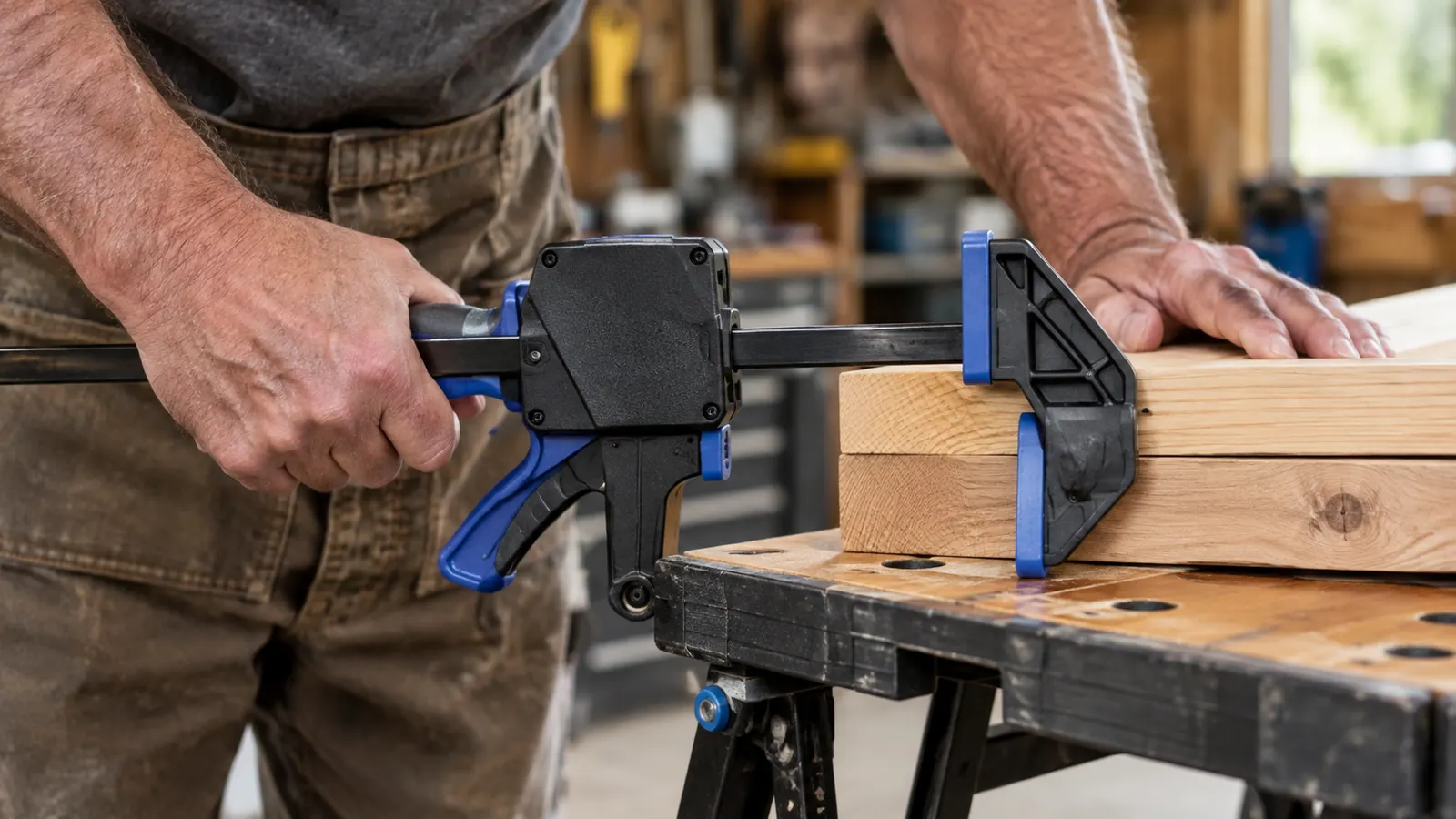
The one-handed trigger is the feature that sold me. You squeeze the handle to open the jaws, slide the clamp into place, and release to lock. To tighten, you keep squeezing. To release, you press the trigger and the jaw opens. It sounds simple because it is simple. But after years of spinning C-clamps with my right hand while trying to hold a board with my left, simple is exactly what I needed.
One Saturday in September, I spent the morning replacing three rotted boards on my back deck. Each board was 8 feet long, and I needed to hold it flat against the joists while I drove screws every 12 inches. With a C-clamp, I would have been juggling the board, the clamp, and the drill all at once. Instead I set two IRWIN clamps on the near end, walked to the far end, and worked my way back down the seam. The whole job took maybe 40 minutes, and I did not drop a single screw. That was the day I stopped thinking of these clamps as a nice idea and started thinking of them as the tool I reach for first. I have replaced a lot of deck boards over the years, and this was the least fuss I have ever had with one.
What Nobody Tells You About the Trigger
Here is the honest part. The trigger mechanism is brilliant, but it has a learning curve. The first few times I used the clamps, I squeezed too hard and the jaw closed faster than I expected. I also had a moment where I released the trigger before the clamp was seated, and the whole thing popped off the board. You will do that once. Then you will learn to seat the clamp first and squeeze second.
The other thing nobody tells you is that the trigger requires a deliberate squeeze, not a gentle one. If you have arthritis or weak grip strength, you will feel it after a long session. I do not have arthritis, but I do have hands that get tired after an afternoon of clamping. I found that I could rest my palm on the back of the clamp and use my whole hand to squeeze, which spread the effort out. That helped a lot.
There is also a small quirk with the release. On a few of my clamps, the release trigger needs a slightly firmer press than the others. It is not a defect. It is just the way the mechanism settles in. After a few weeks of use, all four of mine loosened up and now feel consistent. If you get a pack where one clamp feels stiff, give it some use before you decide it is a problem.
The first real mishap happened on a Thursday evening, two days after the pack arrived. I was regluing a split in an old maple cutting board, and I was in a hurry because the wood glue was open and starting to skin over. I squeezed the trigger, slid the clamp onto the board, and let go before the jaws had seated. The clamp popped off, the board shifted, and glue ran down my fingers. I cleaned it up, wiped the joint, and tried again with the clamp seated first and squeezed second. It held perfectly. That cutting board is still in my kitchen, and I think of that lesson every time I pick up one of these. The funny part is that the clamp did exactly what the instructions said it would do. I just did not believe the instructions, so I learned the hard way in about thirty seconds.
The trigger is brilliant, but it has a learning curve. You will pop a clamp off a board once. Then you will learn to seat it first and squeeze second.
Clamping Power: What It Can and Cannot Do
Let me be direct about clamping force. These are mini bar clamps, and they are not going to replace a heavy-duty bar clamp or a pipe clamp. For big glue-ups like a tabletop or a door, you want something with more reach and more muscle. What these do well is hold small to medium pieces firmly while you work. I have used them to clamp a 1x4 to a workbench, hold two pieces of trim together while the glue dried, and keep a drawer face aligned while I drove screws.
The clamping force is enough for most small shop tasks, but it is not infinite. If you really lean into a board, you can feel the clamp flex a little. That is normal for this style of clamp. The tradeoff is speed and convenience. I can set up four clamps in the time it used to take me to set up one C-clamp. For a person who works alone, that speed is worth a lot.
One thing I appreciate is that the pads on the jaws are soft enough to avoid marking softwood. I have clamped pine and poplar without leaving dents, which is more than I can say for some metal clamps I own. The pads are replaceable too, which matters if you do a lot of finishing work and want to keep your clamps from scratching your projects.
I put them to a real test last spring when I built the raised garden bed I had been planning for two years. The frame was made of 2x6 cedar, and I needed the corners square while the screws went in. I set one clamp across each corner, checked the diagonals with my tape measure, and both were within a quarter inch of each other. Then I drove the screws and pulled the clamps off. The bed has now survived a full season of watering, wind, and frost without racking, so the joints held. That is the kind of proof I trust more than any number on a spec sheet.
The 4-Pack Math: Is It the Right Number?
The pack comes with four clamps, and I think that is the right number for most people. Two is not enough for a glue-up where you need even pressure across a seam. Six is more than most weekend projects need. Four lets you clamp both ends of a board and still have two left for the middle. I have used all four at once on several occasions, and I have also used just one when I needed a third hand to hold something in place.
If you are buying your first set of clamps, start with the 4-pack. If you already have a few clamps and just want something quick for small jobs, the 4-pack is still a good value because you will find yourself reaching for them more than you expect. I did not think I needed four. Now I would not want fewer.
The clearest example of needing all four was a small bookcase I built for one of my grandkids. The sides were 3/4 inch plywood, and I had to glue and screw four shelves into place in one afternoon. I used all four clamps at once, one on each shelf, and left them overnight. In the morning the joints were tight, with no gaps along the seams. If I had owned only two clamps, I would have had to do the job in two passes and hope the first set of shelves did not shift while I worked on the second. That one project convinced me that four is the right number, not two and not six.
Who This Is For
These clamps are for the weekend DIYer who is tired of fighting with tools that require three hands. They are for the person who is gluing up a small project, holding trim in place, or just needs a quick way to keep two pieces of wood together while the screws go in. They are also for anyone with smaller hands or less grip strength who has struggled with traditional C-clamps. The one-handed trigger makes a real difference when you are working alone.
I also think they make a great gift for someone who is just starting to build a workshop. A pack of four clamps is the kind of tool that does not seem exciting until you need it, and then you wonder how you ever worked without it. I have bought a pack for a friend who was setting up her first workbench, and she told me later that they were the tool she reached for most.
Who Should Skip It
If your projects are mostly large glue-ups, cabinet building, or anything that needs deep reach and serious clamping pressure, these are not the clamps for you. You want a longer bar clamp or a pipe clamp for that work. These mini clamps are not a replacement for a full-size clamp. They are a complement to it.
I would also say that if you already own a good set of small C-clamps and you are happy with them, you do not need these. The IRWIN Quick-Grip clamps are faster and easier, but they are not magic. They will not make a bad glue-up good. They will just make the process less frustrating. If your current system works, keep it.
What I Would Change
If I could change one thing about the IRWIN Quick-Grip mini bar clamps, it would be the release trigger. I wish it were a little larger and easier to press when I am wearing work gloves. In the winter, my garage is cold, and I often work with gloves on. The release trigger is small enough that I have to take a glove off to press it comfortably. That is a small thing, but it is the one thing that annoys me every time it happens.
I would also like a small hook or hole on the body so the clamps could hang on a pegboard. Right now I keep mine in a box, which is fine, but hanging them would make them even easier to grab. These are minor complaints. They do not change my recommendation. I just want to be honest about the things that are not perfect.
What I Liked
- One-handed trigger makes clamping fast and easy, even for smaller hands
- Soft pads protect softwood from dents and marks
- Four clamps in the pack is the right number for most small projects
- Compact size stores easily and travels well in a tool bag
- Release action is smooth and reliable after a short break-in period
Where It Falls Short
- Release trigger is small and awkward with work gloves on
- Not enough clamping force or reach for large glue-ups
- Trigger has a learning curve; you will pop a clamp off a board at least once
- No built-in hanging hole for pegboard storage
How They Compare to What I Used Before
Before I bought the IRWIN Quick-Grip clamps, I used a mix of C-clamps and spring clamps. The C-clamps gave me plenty of pressure, but they were slow to set up and even slower to take down. The spring clamps were fast but did not have enough grip for anything that needed real pressure. These mini bar clamps sit right in the middle. They are faster than a C-clamp and stronger than a spring clamp, and they do not leave the marks that spring clamps sometimes do.
The closest comparison is probably a small quick-release bar clamp, but the one-handed trigger is what sets these apart. With a traditional bar clamp, you have to crank the handle to tighten and loosen. With these, you just squeeze. When you are holding a board in one hand and a drill in the other, that difference is the whole ballgame.
The Bottom Line
The IRWIN Quick-Grip mini bar clamps are not the most powerful clamps I own, and they are not the cheapest. They are the ones I reach for first, and that is the highest compliment I can give a tool. If you do small projects, work alone, or just want to stop fighting with C-clamps, these will make your life easier. If you need to clamp something big, buy a bigger clamp. But for the everyday jobs, these are the ones that earn their spot on the bench.
Stop fighting with C-clamps on small jobs
The 4-pack of IRWIN Quick-Grip mini bar clamps is the fastest way to make small projects less frustrating. Check today's price on Amazon and see if they earn a spot on your bench too.
Amazon Check Today's Price on Amazon →