
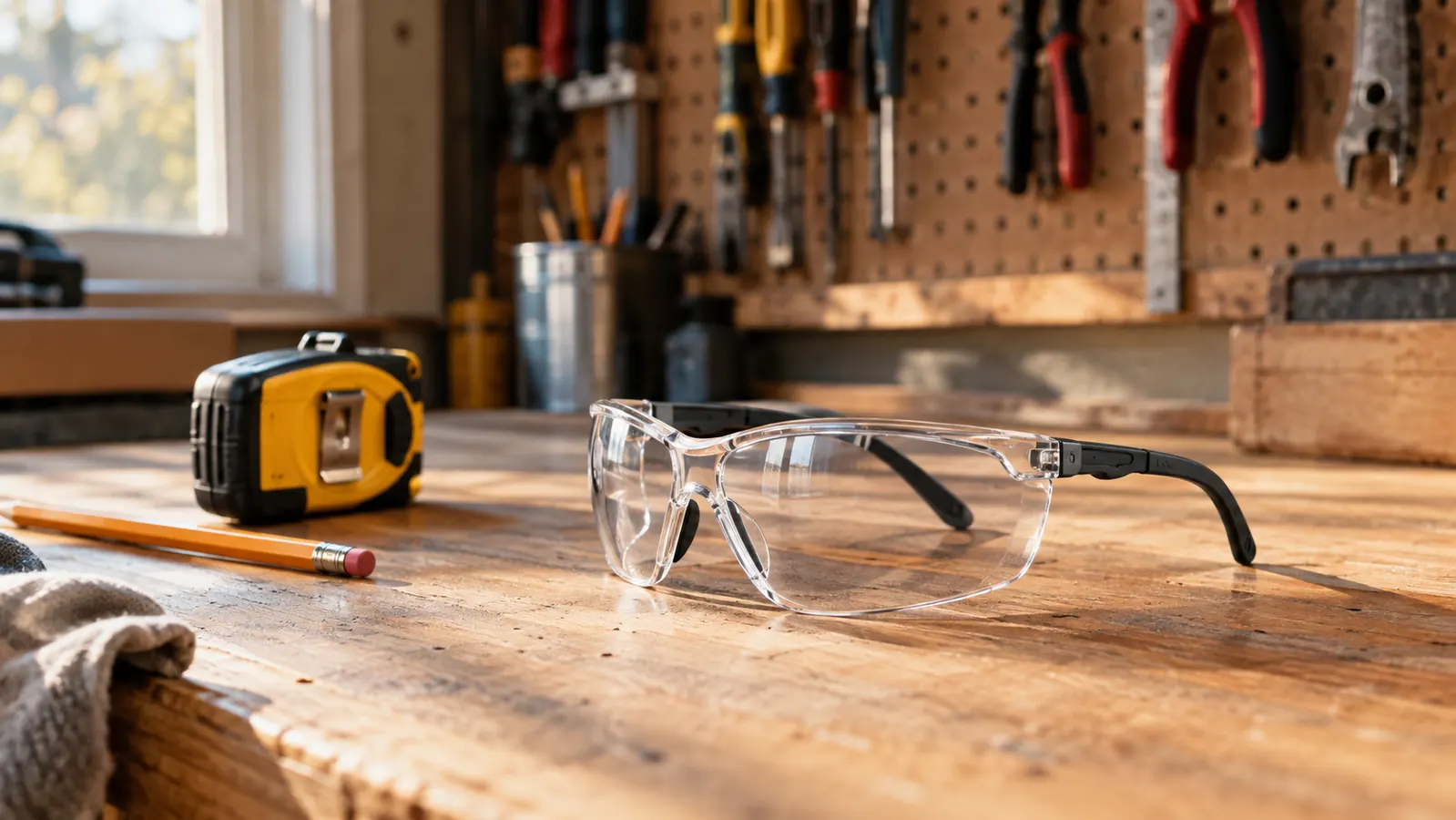
The first time I walked into the hardware aisle to buy safety glasses for woodworking, I stood there too long. There were tinted lenses and clear lenses, cheap pairs in a bin and boxed pairs that cost ten times as much, and nothing on the package told me which one would actually stay on my face while I ran a circular saw. I bought the cheap ones. They slid down my nose on the second cut, fogged up by the third, and spent the rest of the afternoon on top of my head. That is how I learned that choosing safety glasses for woodworking is less about the price tag and more about fit, lens, and how the thing behaves when you are actually working.
Since then I have worked my way through a lot of pairs in my garage workshop outside Spokane. The pair I keep reaching for, and the one I recommend to anyone who asks, is the NoCry clear safety glasses with adjustable frames. They are not the fanciest pair I own. They are the ones that stay put, stay clear, and cost less than a tank of gas. Here is how I think through the choice, step by step, so you do not have to stand in that aisle as long as I did.
The Pair I Reach for Every Time I Walk Into the Garage
After a year of sawdust, splinters, and one memorable ricochet off a knot in a pine board, the NoCry clear safety glasses are the ones on my workbench. Adjustable temples, no-slip grips, and a scratch resistant lens that has outlasted every cheap pair I ever bought.
Amazon Check Today's Price on Amazon →Step 1: Look for the ANSI Z87.1 Rating First, Before Anything Else
This is the one thing I will not bend on. ANSI Z87.1 is the American National Standards Institute rating for impact resistant eye protection. It means the lenses have been tested against high velocity impact and the frames have been tested too. When a chunk of wood kicks back off a table saw at speed, that rating is the difference between the glasses absorbing the hit and the glasses becoming part of the problem.
The NoCry pair is ANSI Z87.1 rated, and that is the first thing I check on any pair I consider. If a package does not say it, I put it back. There are plenty of stylish pairs that look like safety glasses but are really just fashion frames with clear lenses. They will not do the job when it counts.
One honest note: the rating covers impact, not everything. It does not mean you can skip common sense, like unplugging a saw before you change the blade. But it does mean the glasses themselves are not the weak link. That is the whole point.
Here is how I check it in the store. Turn the glasses over and look at the inside of the temple arm or the top of the lens. A real Z87 pair has the marking molded or printed right there, usually as Z87 or Z87+. The plus sign means the lens passed the high velocity impact test, which is the one that matters when a chunk of knot flies off a miter saw blade. If the only place you can find the rating is on the cardboard, put them back. Packaging gets swapped. The frame does not lie.
Step 2: Get a Pair with Adjustable Frames That Fit Your Actual Face
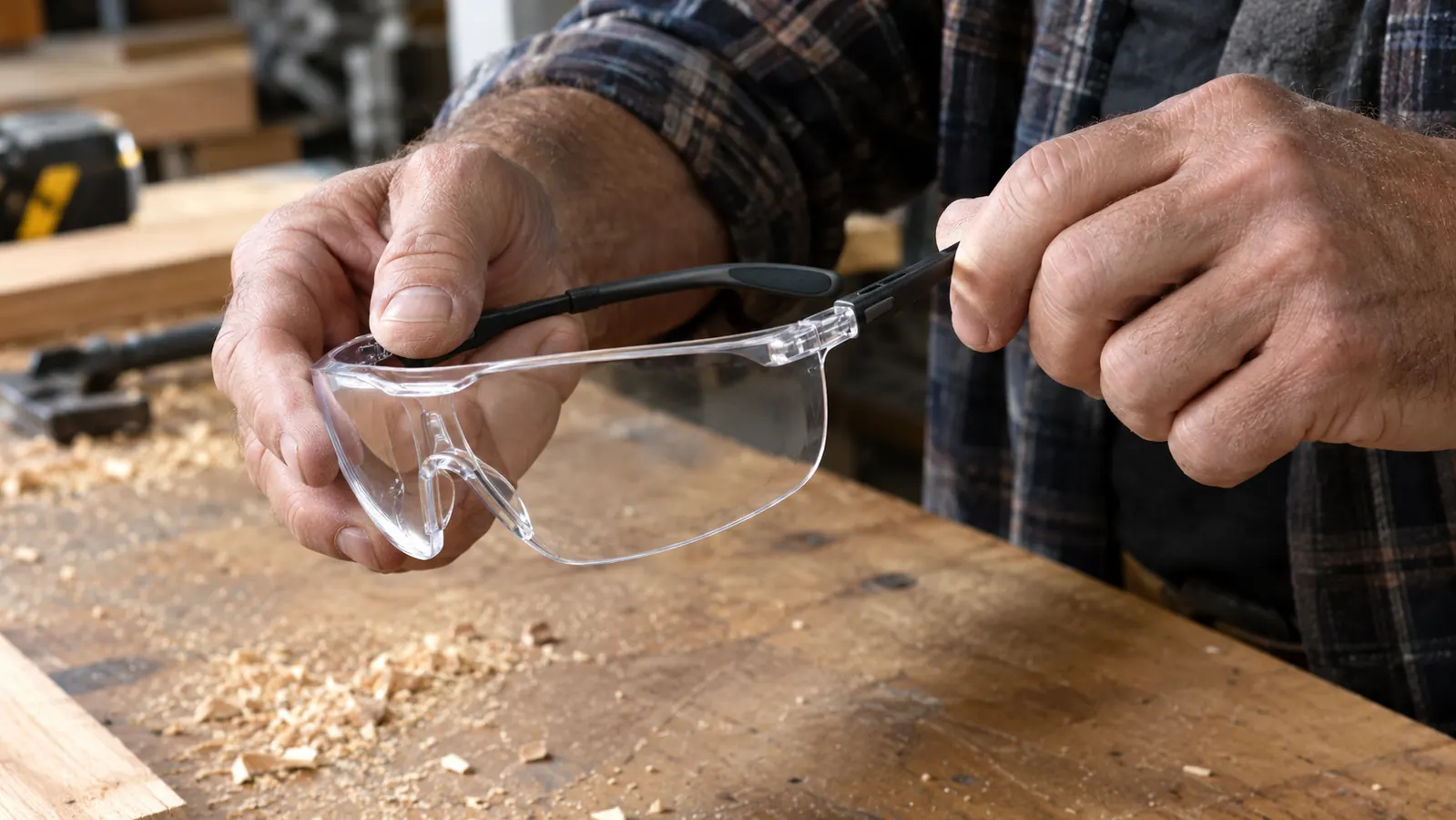
Here is the problem with one-size-fits-all safety glasses: faces are not one size. I have a narrower face and a smaller head than a lot of folks, and most standard pairs sit loose, slide down when I look down at a cut line, and leave a gap at the top where sawdust lands right in my eye. That gap is how I ended up blinking dust out of my eye in the middle of a cut more than once.
The NoCry glasses have adjustable temple arms, which means you can shorten or lengthen them to fit your head. That simple adjustment changed everything for me. The glasses sit snug without pinching, they do not slide when I lean over the workbench, and they stay put when I look down at the saw blade. If you wear glasses or have a head that never quite matched the standard fit, this is the feature to look for.
The no-slip grips on the temples help too. They keep the glasses from creeping forward when you are moving around the shop, reaching for a clamp, or bending down to pick up a board. A pair that stays put is a pair you will actually wear, and a pair you wear is a pair that can protect you.
To test the fit, put them on and look straight down at the floor, then shake your head a little like you are saying no. If they slide down your nose or tip forward, they will do the same thing when you lean over a board to line up a cut. Then look up at the ceiling. If the top of the frame digs into your eyebrows or the bottom rests on your cheeks, the glasses will fog and pinch within ten minutes. The NoCry pair passed both tests on my face once I set the temple arms one notch shorter than where they came out of the box.
Step 3: Choose Clear Lenses for Indoor Work and Save the Tint for Outside
For most woodworking, clear lenses are the right call. Tinted lenses make it harder to see the grain of the wood, the pencil line you just drew, and the subtle change in color that tells you the cut is going well. In a garage or workshop with decent lighting, clear lenses give you the truest view of what you are doing.
The NoCry clear pair also has a scratch resistant coating, which matters more than you might think. Safety glasses get set down on workbenches, dropped into toolboxes, and wiped off with whatever rag is handy. A lens that scratches easily will be cloudy within a few months, and a cloudy lens is a hazard in its own way because you will be tempted to take the glasses off to see better. Mine have held up through a year of that treatment and still look clear.
They also offer superior UV protection, which is a nice bonus if you work outside on a sunny day. But for the woodworking itself, the clear lens is the feature I care about. Save the tinted pair for mowing the lawn or working in the yard.
A word about readers. Many of us past fifty need a little magnification to see a pencil line, and squinting through safety glasses at a tape measure is how cuts end up an eighth of an inch off. I keep my drugstore readers on a cord and slide the NoCry glasses on over them for close layout work. That works because the NoCry frame is roomy enough to fit over a small pair. If you wear full size prescription glasses, look for a pair sold specifically as over the glasses, because a standard frame will press your own glasses into your nose.
Step 4: Check the Anti Fog, Because Fog Is the Real Reason People Stop Wearing Glasses
I will tell you the honest truth: the reason most safety glasses end up on top of a person's head is not that they are uncomfortable. It is that they fog up the second you start breathing hard, and you cannot see the cut, so you push them up and leave them there. I have done it. Every woodworker I know has done it.
The NoCry glasses have an anti fog coating, and it works better than any pair I have tried. They still fog a little on a hot, humid day if I am really working up a sweat, but it clears quickly and it does not turn into the constant haze I got with cheaper pairs. That is the difference between a pair you keep on and a pair you keep pushing up.
A small tip that helps any pair: wash the lenses with mild soap and water when they are new, then let them air dry. It removes the manufacturing residue that makes fog cling. I do that with every new pair, and it makes the anti fog coating work even better.
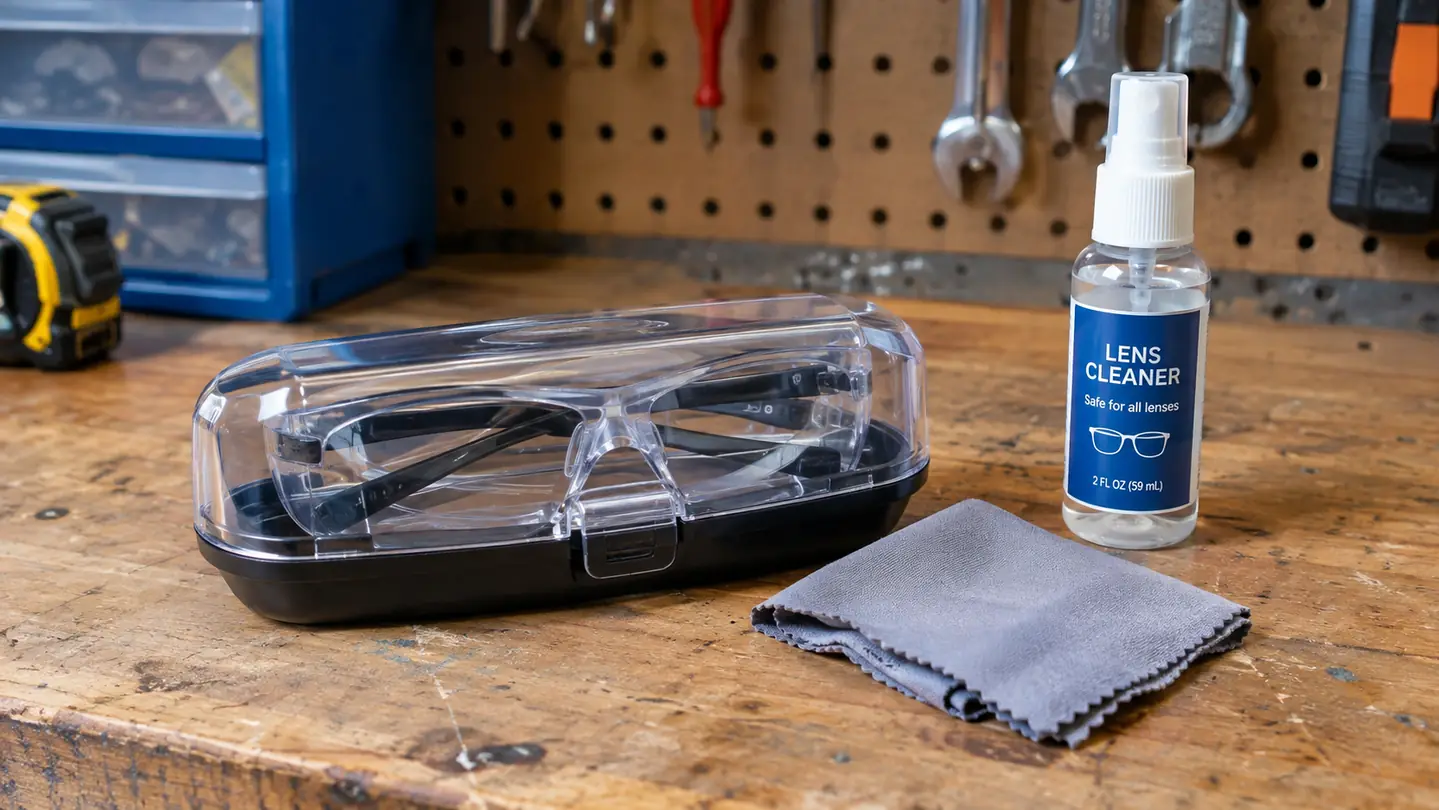
I learned the hard way not to wipe dry lenses with my shirt. Sawdust is gritty, and dragging it across a coated lens is like using fine sandpaper. Now I give the NoCry glasses a quick rinse under the utility sink, shake them off, and dry them with the microfiber cloth that came in the case. On a cold morning in the garage I also set them on the workbench for a few minutes before I start, so the lenses warm up to the room and do not fog the second I put them on.
Step 5: Buy a Pair You Can Keep Handy, Because the Best Glasses Are the Ones Within Reach
The best safety glasses in the world do nothing if they are in the house while you are in the garage. I keep my NoCry pair on the pegboard wall next to the door, right beside my hearing protection. When I walk in, I put them on before I pick up a tool. When I walk out, they go back on the peg. It takes two seconds, and it means I never have to decide mid-project whether it is worth walking back inside to get them.
The NoCry glasses are lightweight enough that I forget I am wearing them, which is the highest compliment I can give a piece of safety gear. They do not pinch my temples, they do not leave red marks after an afternoon of work, and they do not make me feel like I am wearing goggles from a chemistry class. They just sit there and do the job.
They come with a case and a microfiber cloth, which sounds like a small thing until you have spent ten minutes looking for a pair of glasses you set down somewhere in the shop. The case lives in my toolbox now, and the cloth lives in the case, so I always know where both are.
Where you store them matters as much as which pair you buy. I hang mine on a hook right next to the light switch at the garage door, so I see them before I touch a single tool. Some folks keep a second pair clipped to the shop vac or the miter saw stand. Whatever you do, keep them out of the bottom of a tool bag, where a loose chisel or a drill bit will scratch the lenses within a week. Scratched lenses get blurry, blurry lenses get pushed up on your forehead, and glasses on your forehead protect nothing.
What Else Helps
Safety glasses are the start, not the whole story. I pair mine with a simple dust mask for sanding, hearing protection for anything loud, and a shop vac that catches most of the fine dust before it hangs in the air. I also keep a spare pair of the NoCry glasses in the house for the days I forget to bring the pegboard pair back in. For the price of a couple of coffees, having a backup means I am never tempted to skip eye protection because I cannot find my glasses.
A pair that stays put is a pair you will actually wear, and a pair you wear is a pair that can protect you.
Stop Squinting and Start Cutting
You do not need a drawer full of safety glasses. You need one pair that fits, stays clear, and stays on your face. The NoCry clear safety glasses with adjustable frames are the pair I reach for every time I walk into my garage.
Amazon Check Today's Price on Amazon →